nutrigenomics
Evolution of alcohol tolerance — Friend or Foe?
6 min read
Have you ever wondered why humans can metabolize alcohol at all, and why some people tolerate it far better than others? The ability is not an accident. It reflects a long evolutionary history, a few surprising enzymes, and some genetic differences that still shape who flushes, who gets ill, and who is at higher risk of cancer today. This post follows that story from fruit-eating apes to modern drinkers.
Ethanol, briefly
"Alcohols" are a large family of compounds carrying one or more hydroxyl (–OH) groups. Methanol (wood alcohol) and isopropanol (rubbing alcohol) are poisonous. When people say "alcohol" about a drink, they mean ethanol, the only one the body can handle in any tolerable quantity, and even that depends on dose and on the genetic factors we will get to below.
Ethanol is small and dissolves in water, so it crosses membranes by simple diffusion and needs no transporters. Absorption begins in the mouth and stomach, and most of it happens in the small intestine.
It also sits oddly among the nutrients. Fully oxidized, ethanol yields about 7 kcal per gram, so it is sometimes called a fourth macronutrient. But it is not essential, and its metabolism produces toxic intermediates. That is why methanol poisoning is treated with ethanol (or fomepizole): the two compete for the same liver enzyme, and occupying it with ethanol stops methanol being converted into its far more toxic products.[1GuidelineAmerican Academy of Clinical Toxicology practice guidelines on the treatment of methanol poisoningRecommends blocking the formation of toxic methanol metabolites with fomepizole or ethanol.Click for the full reference]
A short history of drinking
Humans have been making alcohol for a very long time. Chemical residues in pottery from the Neolithic village of Jiahu in China show a fermented drink of rice, honey and fruit was being produced as early as the seventh millennium BC.[2Lab / animalFermented beverages of pre- and proto-historic ChinaChemical residues in pottery from Jiahu, China, show a fermented rice, honey and fruit drink was being made in the seventh millennium BC.Click for the full reference] Today alcohol is part of the diet of more than half the world's population, woven into religion, ritual and cuisine, and forbidden in others, for example in Islam.
But the story of ethanol in the primate diet starts far earlier than brewing.
Our ancestors were already drinking
Roughly 10 million years ago our ancestors were largely fruit eaters, and ripe fruit is a natural source of ethanol, because yeast ferments its sugars. The drunken monkey hypothesis proposes that attraction to the faint smell of ethanol helped primates find ripe, energy-rich fruit, and that this once-useful attraction may underlie modern drinking.[3BookThe Drunken Monkey: Why We Drink and Abuse AlcoholArgues that primates' attraction to low-level ethanol in ripe fruit goes back tens of millions of years and may underlie modern drinking.Click for the full reference]
There is molecular evidence to match. By resurrecting ancestral versions of the digestive enzyme ADH4, researchers found that the enzyme of older, tree-dwelling ancestors barely oxidized ethanol, while a single change in the lineage leading to humans, chimpanzees and gorillas, about 10 million years ago, made it efficient. The timing coincides with a shift to feeding on the forest floor, where fallen fruit carries more yeast and more ethanol.[4Lab / animalHominids adapted to metabolize ethanol long before human-directed fermentationA digestive enzyme (ADH4) able to oxidize ethanol efficiently appeared in the ancestors of African apes and humans about 10 million years ago, around when they began feeding on the forest floor.Click for the full reference]
So the answer to "why do we have an alcohol-processing system if alcohol isn't a nutrient we need?" is at least partly: because ethanol was a regular, low-dose part of the diet long before anyone brewed anything.
How the body handles ethanol
In the liver, ethanol is broken down in two steps:
Ethanol → (ADH) → acetaldehyde → (ALDH) → acetate
- Alcohol dehydrogenases (ADH) convert ethanol to acetaldehyde.
- Aldehyde dehydrogenases (ALDH), mainly ALDH2 in mitochondria, convert acetaldehyde to acetate, which the body can use for energy.
At low doses this is the main route. With heavy drinking, a second system, the microsomal ethanol-oxidizing system (CYP2E1), takes on more of the load, and catalase makes a smaller contribution. The human genome has around 20,000 protein-coding genes, and among them the ADH and ALDH families are the ones that matter most for this story.
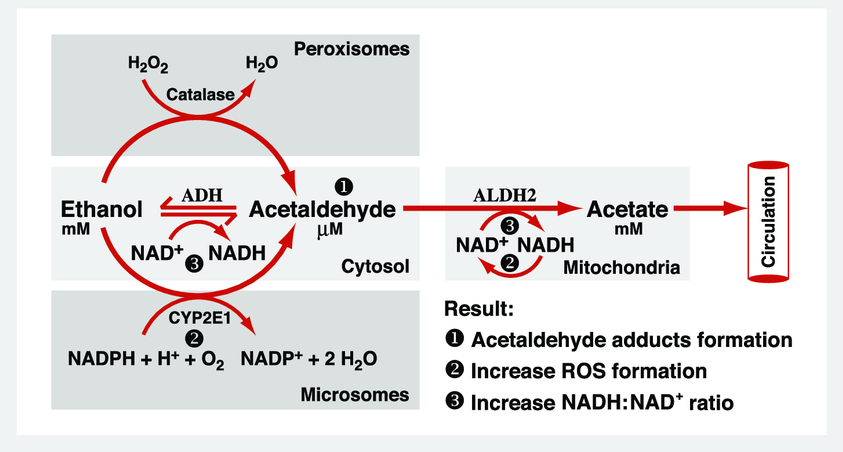
Why acetaldehyde is the real problem
Metabolic pathways often evolve step by step, with each new enzyme building on the previous one. Ethanol metabolism is a good example of why that intuition can mislead. The second enzyme, ALDH, belongs to an ancient and widely conserved superfamily that detoxifies aldehydes produced by ordinary metabolism, not just by alcohol.[5ReviewFrom algae to vascular plants: the multistep evolutionary trajectory of the ALDH superfamily towards functional promiscuity and the emergence of structural characteristicsAldehyde dehydrogenases are an evolutionarily conserved superfamily that converts a wide range of aldehydes to carboxylic acids.Click for the full reference] That matters, because acetaldehyde is far more toxic than ethanol itself. An ADH that produced acetaldehyde with no ALDH to clear it would have been a liability, not an adaptation. Plausibly, the machinery for handling aldehydes was already in place when efficient ethanol oxidation appeared.
This also explains why acetaldehyde is central to alcohol's health effects. The WHO's cancer agency (IARC) classifies alcohol consumption as carcinogenic to humans.[6ReviewA review of human carcinogens—Part E: tobacco, areca nut, alcohol, coal smoke, and salted fishThe IARC working group reassessed alcohol and its links to several cancers.Click for the full reference]
Populations differ, and it shows in the genes
Genetic variants in ADH and ALDH are among the clearest examples of nutrigenetics in action.
- ADH1B: a fast-acting variant (His47) is common in East Asia and, in other forms, in people of African descent. It converts ethanol to acetaldehyde quickly and is protective against alcohol use disorder.
- ALDH2: a near-inactive variant is found almost only in East Asians. Acetaldehyde builds up after even a little alcohol, causing the familiar flushing, palpitations and nausea.[7ReviewAlcohol dehydrogenases, aldehyde dehydrogenases, and alcohol use disorders: a critical reviewFunctional variants in ADH1B and ALDH2 are the strongest known genetic influences on alcohol use disorder; the ALDH2 variant is essentially confined to people of East Asian ancestry.Click for the full reference]
Two of these findings connect to human history. The fast ADH1B His47 allele appears to have arisen about 7,000–10,000 years ago in southern China, alongside the spread of rice cultivation, and its geographic pattern matches the archaeology.[8Genetic associationThe ADH1B Arg47His polymorphism in East Asian populations and expansion of rice domestication in historyIn 38 populations (2,275 people), the fast-acting ADH1B His47 allele dated to roughly 7,000–10,000 years ago, matching the spread of rice farming.Click for the full reference] And the flush is not harmless: among people with ALDH2 deficiency who drink heavily, the risk of esophageal cancer is much higher, which is why the flushing response is now considered a meaningful risk marker rather than a curiosity.[9ReviewThe alcohol flushing response: an unrecognized risk factor for esophageal cancer from alcohol consumptionPeople with the flushing response (mostly ALDH2 deficiency, about 8% of the world's population) who drink heavily have a much higher risk of esophageal cancer.Click for the full reference]
So why do we drink?
Biology explains the capacity, not the culture. Alcohol has been used for medicine, ritual and celebration, and it is tightly tied to social bonding. In one UK survey, people who ate socially more often reported greater happiness and stronger support networks, and the meals that made them feel closest involved more laughter and, often, alcohol.[10Cohort studyBreaking bread: the functions of social eatingIn a UK survey, people who eat socially more often report being happier and better supported; meals that felt more bonding also involved more laughter and alcohol.Click for the full reference] That is an association, not proof that alcohol creates bonding, but it fits the idea that a substance our ancestors were already tolerating became a social tool.
Today the amount of ethanol many people consume is vastly higher than anything a fruit-eating ancestor met, which is where the "friend" starts to look like a "foe".
Take-home
- The ability to process ethanol is at least 10 million years old and predates human brewing.[4Lab / animalHominids adapted to metabolize ethanol long before human-directed fermentationA digestive enzyme (ADH4) able to oxidize ethanol efficiently appeared in the ancestors of African apes and humans about 10 million years ago, around when they began feeding on the forest floor.Click for the full reference]
- The dangerous intermediate is acetaldehyde; genes that speed up its production or slow its removal change your risk.
- ADH1B and ALDH2 variants vary by ancestry and are among the strongest genetic influences on drinking behaviour and alcohol-related cancer risk.[7ReviewAlcohol dehydrogenases, aldehyde dehydrogenases, and alcohol use disorders: a critical reviewFunctional variants in ADH1B and ALDH2 are the strongest known genetic influences on alcohol use disorder; the ALDH2 variant is essentially confined to people of East Asian ancestry.Click for the full reference]
- If alcohol makes you flush, that is a biological signal, not something to push through.
Sources
- Barceloux DG et al. (2002). American Academy of Clinical Toxicology practice guidelines on the treatment of methanol poisoning. Journal of Toxicology – Clinical Toxicology 40(4):415–446. GuidelineRecommends blocking the formation of toxic methanol metabolites with fomepizole or ethanol.
- McGovern PE et al. (2004). Fermented beverages of pre- and proto-historic China. PNAS 101(51):17593–17598. Lab / animalChemical residues in pottery from Jiahu, China, show a fermented rice, honey and fruit drink was being made in the seventh millennium BC.
- Dudley R. (2014). The Drunken Monkey: Why We Drink and Abuse Alcohol. University of California Press. BookArgues that primates' attraction to low-level ethanol in ripe fruit goes back tens of millions of years and may underlie modern drinking.
- Carrigan MA et al. (2015). Hominids adapted to metabolize ethanol long before human-directed fermentation. PNAS 112(2):458–463. Lab / animalA digestive enzyme (ADH4) able to oxidize ethanol efficiently appeared in the ancestors of African apes and humans about 10 million years ago, around when they began feeding on the forest floor.
- Stiti N, Giarola V, Bartels D. (2021). From algae to vascular plants: the multistep evolutionary trajectory of the ALDH superfamily towards functional promiscuity and the emergence of structural characteristics. Environmental and Experimental Botany 185:104376. ReviewAldehyde dehydrogenases are an evolutionarily conserved superfamily that converts a wide range of aldehydes to carboxylic acids.
- Secretan B et al. (2009). A review of human carcinogens—Part E: tobacco, areca nut, alcohol, coal smoke, and salted fish. The Lancet Oncology 10(11):1033–1034. ReviewThe IARC working group reassessed alcohol and its links to several cancers.
- Edenberg HJ, McClintick JN. (2018). Alcohol dehydrogenases, aldehyde dehydrogenases, and alcohol use disorders: a critical review. Alcoholism – Clinical and Experimental Research 42:2281–2297. ReviewFunctional variants in ADH1B and ALDH2 are the strongest known genetic influences on alcohol use disorder; the ALDH2 variant is essentially confined to people of East Asian ancestry.
- Peng Y et al. (2010). The ADH1B Arg47His polymorphism in East Asian populations and expansion of rice domestication in history. BMC Evolutionary Biology 10:15. Genetic associationIn 38 populations (2,275 people), the fast-acting ADH1B His47 allele dated to roughly 7,000–10,000 years ago, matching the spread of rice farming.
- Brooks PJ, Enoch MA, Goldman D, Li TK, Yokoyama A. (2009). The alcohol flushing response: an unrecognized risk factor for esophageal cancer from alcohol consumption. PLoS Medicine 6(3):e1000050. ReviewPeople with the flushing response (mostly ALDH2 deficiency, about 8% of the world's population) who drink heavily have a much higher risk of esophageal cancer.
- Dunbar RIM. (2017). Breaking bread: the functions of social eating. Adaptive Human Behavior and Physiology 3:198–211. Cohort studyIn a UK survey, people who eat socially more often report being happier and better supported; meals that felt more bonding also involved more laughter and alcohol.
How to read the study labels
- Randomized trial:
- Participants are assigned an intervention by chance, so it can show cause and effect.
- Cohort study:
- Follows people over time. It shows associations, not proof of cause.
- Genetic association:
- Links a gene variant to a trait in a population. Effects are usually modest.
- Lab / animal:
- Shows a mechanism is possible; it may not carry over to humans.
- Review:
- A summary of many studies by experts.
- Guideline:
- Consensus recommendations from a professional body.
- Book:
- A synthesis by one author or group; read it alongside primary studies.